I need to be in the right mindset to tackle denser games, but those times don’t always correspond to the moments when I actually have the free time to play or write about video games. So I’ll usually keep something a little lighter in progress, a game that I can pop into and out of on the days where I’m not in the mood for the heavier stuff, or for when I’ve finished something big and am reflecting on the experience while deciding what to do next. I was looking for something to bridge the gap between Chicory and whatever the next big experience would be*, when I landed on Monster Prom.

*"The Next Big Experience" wound up being Heaven’s Vault, and there’s a reasonable chance something on that will be coming, if I ever get my thoughts in order.
Monster Prom, for the unfamiliar, is a visual novel from a few years ago by developer Beautiful Glitch. Late last year it got a follow-up, Monster Camp, which uses the same base set-up for a whole bunch of new scenarios with different characters. And a big part of what makes the game unique, as it even markets, is that it’s a competitive dating sim; you can compete against your friends, both going about your life as a monster student talking to potential romantic interests while trying to block your friends from getting the stats or interactions they need to succeed.*
*Although you can also both win, if you play your cards right; but you’ll likely get in each other’s way at least once, even if you’re pursuing different partners. Also, you can also absolutely play it as a single player, taking a Solitaire-style “beat the game” approach. It’s surprisingly difficult, in this regard! I failed at least as often as I succeeded, and you definitely need to strategize to pull off a successful run (particularly in the sequel, which feels even tougher).
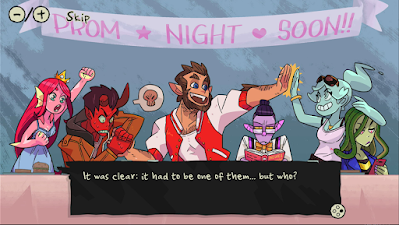 As you might guess by that set up, it’s a game that prioritizes replayability even more highly than most other dating sims, with a focus on shorter run times and tons of potential routes and events within each route. If you wanted to slam even more buzzword genres onto it, I suppose you could even call it a roguelike dating sim. I’ve stated before that it’s hard to tell whether a video game’s idea is totally unique, as so much of making a game is iteration and mutating other interesting ideas, and there’s hardly any sort of online compendium tracking the introduction and evolution of every different mechanic and story element (even before getting into how fuzzy those distinctions can get). Even still, my efforts to find other multiplayer or roguelike visual novels and dating sims mostly came up empty (I got a small few for the latter, but most of them seemed very different from the Monster series at best).
It also helps that the game itself is a lot of fun to play, even over dozens of replays. Monster Prom has a madcap, manic approach to its writing; dozens of recognizable school set-ups are distorted through the monster world, which is governed by an “everything can and will go awry in the most disastrous fashion” logic. Skipping class somehow leads to forming a crime ring, sneaking in to change a grade leads to a coup plot on the Water Polo team, the party after school leads to summoning demons to spice things up, stuff like that (and the game is more than happy to get dark in its craziness; they are all monsters, after all). Monster Camp draws things out a little bit, keeping the absurdity but wrapping it in more long-form scenarios that often start in ridiculousness and spiral from there. It’s not a huge difference, but it is noticeable enough to give them each their own distinct energies even as they both run headfirst into outright silliness.
*Although you can also both win, if you play your cards right; but you’ll likely get in each other’s way at least once, even if you’re pursuing different partners. Also, you can also absolutely play it as a single player, taking a Solitaire-style “beat the game” approach. It’s surprisingly difficult, in this regard! I failed at least as often as I succeeded, and you definitely need to strategize to pull off a successful run (particularly in the sequel, which feels even tougher).

It also helps that the game itself is a lot of fun to play, even over dozens of replays. Monster Prom has a madcap, manic approach to its writing; dozens of recognizable school set-ups are distorted through the monster world, which is governed by an “everything can and will go awry in the most disastrous fashion” logic. Skipping class somehow leads to forming a crime ring, sneaking in to change a grade leads to a coup plot on the Water Polo team, the party after school leads to summoning demons to spice things up, stuff like that (and the game is more than happy to get dark in its craziness; they are all monsters, after all). Monster Camp draws things out a little bit, keeping the absurdity but wrapping it in more long-form scenarios that often start in ridiculousness and spiral from there. It’s not a huge difference, but it is noticeable enough to give them each their own distinct energies even as they both run headfirst into outright silliness.


