Mailing list

Greeting

The Pop Culture Wing of Hot Corner Harbor

Wednesday, March 16, 2022

Demon Turf is a Great 3D Platformer that Gets Extra Mileage from a Different Approach


I managed to cover a lot of different games in 2021 (and even launched a page to collect all of my indie game reviews!), and consequently, don’t feel the need to write any sort of loose-ends wrap-up piece like I have in years past; I’m not sure there would be enough games or ideas to fill it out. However, there’s still one big game I played last year that I want to cover, a late release that I played towards the end of the year and wound up being one of my favorite games of the year: Fabraz’s Demon Turf.

Demon Turf is a game that I had been excited about for a while. I hadn’t followed any of Fabraz’s earlier games, but I’m always on the lookout for new and upcoming 3D Platformers to try, which is where I first came across it. My excitement only grew upon trying the early demo when it came out on Steam, and then even further after it came out early last year that Playtonic (makers of Yooka-Laylee, among other projects) would be picking it up as one of the first three games in their Playtonic Friends publishing division. Both of those pointed to good things, which got me a little worried that I might be overhyping it.

As it turns out, my concerns were totally unfounded! Demon Turf wound up being my favorite 3D platformer since… probably A Hat in Time? In just every way it’s delightful, but it also manages to squeeze a lot out of its indie game scale; and along the way, it tries a bunch of interesting twists on genre formulas that make the entire thing feel that much fresher.
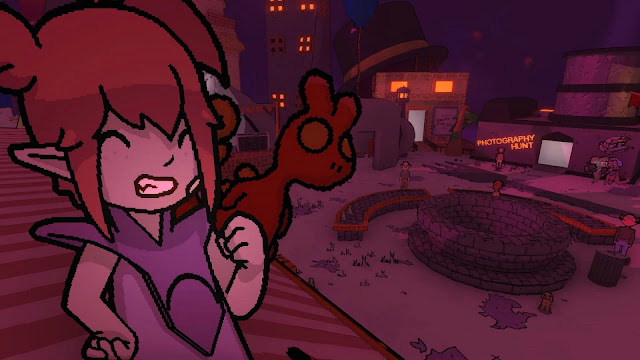


So let’s start with the basic set-up: Demon Turf is about a young demon girl named Beebz, who’s a bit of an outcast in the underworld and plans to rectify that by taking on the Demon King. But to challenge him for the throne, she’ll need to first take over the territories of four other demon gang leaders who serve under the King, which you do by beating all of a world’s levels and then challenging them to boss battles.

It’s a pretty standard 3D platformer set-up at its most basic level. Each level gives you a major, end-of-level collectable, a la Mario’s power stars or Sonic’s emblems (here, it’s batteries), and there are a variety of optional secondary collectables that can get you a variety of unlocks (in this case, sweets). You start in the main hub world, Beebz’s home of Forktown, and from there, travel to one of four smaller world hubs, each of which has seven levels leading off of them like spokes; one easy level lets you into the world’s main square, from which you can tackle the remaining six levels in any order. Collect the battery at the end of every level and you open the boss door.

It’s all pretty standard stuff for this type of game, but Demon Turf pulls it all off well. And really, that extends to the other fundamental mechanics. A lot of work has clearly gone into refining the movement in this game, and it all really shows, as Beebz controls incredibly smoothly.
Wednesday, February 9, 2022

Nexomon: Extinction Offers an Interesting Story and Some Fun Twists on the Monster Collecting Genre


I’ve still been thinking about the Monster Taming genre a lot as of late. Which makes sense; as I’ve said in the past, it’s a game style that means a lot to me. I loved it growing up, and as someone who’s gotten more and more into the indie game sphere, I’m thrilled with the number of small projects tackling the style. New ideas and directions from new talent is really what helps an idea grow.

I got some of my thoughts about this out in my Pokémon 25th Anniversary piece from late last year, which makes sense. Pokémon’s dominance within the genre is undeniable; it’s far and away both the best-selling and most prolific series in the style, both of which make it most people’s introduction and formative experiences with the genre. This also means that a lot of people have opinions on what Pokémon as a series should be, though, especially compared to what it actually is.

My take on it from last year can more or less be summarized as “The mainline series is trying to be the JRPG version of something like Animal Crossing, and most of their changes have either been to enhance that side of the game, or to make the surprisingly-deep competitive side more accessible for those who want the challenge.” And I also think all of that is good, even if it is not yet perfect or to everybody’s taste. It’s a fun vision on the whole.

Of course, that’s also why the growing number of other Monster Taming games is good; no one vision of the genre can sate everyone, and it’s good to have alternatives. Which is why today I’d like to talk up VEWO Interactive’s Nexomon: Extinction, another new entry into the genre, and a very worthwhile one in my estimation.

It’s one of the more directly Pokémon-inspired games I’ve seen, and never quite escapes being “Pokémon, but…”. But I also don’t think that’s necessarily a bad thing; Pokémon at its core is a lot of fun, while also having a ton of variables and decisions that can be adjusted in a number of ways. And I enjoy seeing other people’s potential divergent evolutions of what the series could be, in tweaking these things.


And despite having a fraction of the budget or manpower* of Game Freak, Nexomon: Extinction still provides its own unique voice and polished experience. It’s not going to be for everyone, because again, I don’t know that anything can truly be that, but I do think there’s something here for both people who still enjoy Pokémon and want more new experiences like that, and people who have found the interests drift from the main series but still find themselves missing some aspects of it and wondering what could be.

*Counting the credits, I saw 1 designer/programmer, 1 producer, 6 music credits, and 19 artists and animators.

Unlike with Monster Sanctuary, there really isn’t really a big twist on the base-level Pokémon formula in Nexomon: Extinction. The gameplay still alternates between top-down overworld segments where you explore the game’s world, and turn-based RPG battles where your team of up to six elementally-themed monsters with up to four attacks each takes on either a solo wild Nexomon or opposing trainer teams.

Sunday, February 6, 2022

Music Monday: End of 2021 Playlist

Last year, I did an “end of the year” supplemental playlist to go with my normal summer playlist (which usually ends up covering the first two-thirds of the year anyway), and I kind of liked doing that. So it’s making a return this year to follow up my Summer 2021 list, especially since there’s a lot of good stuff I’ve been listening to since then. Like normal, I’m including a playlist link up top, followed by some stray thoughts on various entries on the list, and then a full text listing at the end. And as per usual, it’s mostly 2021 stuff, but I’m also only one person doing this on the side, so sometimes it takes me a while to get around to trying things.


To start: last time, I called CHVRCHES Screen Violence my album of the summer, and if I had one complaint, it was that it felt a little shorter than their last few albums. Well, they released a bonus version in late October that included three new songs, all of which are stellar. Especially “Killer”, which might be my favorite song on the album now? “How Not to Drown” is hard to top, though.

Moving on from my favorite album on the last list, to my favorite album on this list: it’s Mercurial World by Magdalena Bay, which has been living in my brain for the past month or two. Every song is just great, layers upon layers of hooks and melodies and interesting things. It’s almost hard for me to pick three songs off of it, but “Hysterical Us” is probably my favorite track (I absolutely love that main piano riff). And “Secrets (Your Fire)” feels like the perfect introductory single to the album (I think it was the first track of theirs that I heard, although I’m not positive), plus it’s such a smooth jam. A third pick from the album was difficult, since there are so many good songs. Just by how much I enjoy the songs, I’d probably go with album closer “The Beginning”, but I think part of what I like about it is how it works as a final track, so I left it as a surprise. After that, it was a tough call between the title track, “Chaeri”, “You Lose!”... but I ended up going with “Dawning of the Season”.

Friday, December 3, 2021

Some More Indie 3D Platformer Recommendations, Part 2: Blue Fire and Toree

Today brings the second part of my round-up of indie 3D platformers, in order to keep both halves more manageable in length. If you missed the first part earlier this week, where I looked at Tasomachi: Behind the Twilight and Here Comes Niko!, check it out here. Once you’ve read that, we can jump right into the second half:


Blue Fire (Robi Studios)


Of all of the games I’m covering in this two-parter, Blue Fire might be the one I went into with the least idea of what to expect? I wasn’t too familiar with anyone involved, I just saw a trailer and decided that it looked interesting. And in that regard, I was pretty pleasantly surprised!

Blue Fire is the debut work of Robi Studios, and it’s a pretty strong opening statement. It’s by far the one here with the deepest lore, so that’s another plus (although it’s also the type of game that gives out said lore via exploration, so don’t expect a big explanation right off the bat). To not give too much away, you play as Umbra, a mysterious figure who wakes up in a ruined lab deep underground. Upon a little exploring, you learn that you are in the depths of a floating castle called Penumbra, built to protect the remnants of the world from an encroaching mass of shadows that long ago engulfed the earth below and now tries to infect the castle. You guide Umbra to learn the causes of these shadows, and to see if they can be stopped.

I’ve seen some compare the game’s world and story to Dark Souls, and I can’t really comment on that, as I haven’t played them. The other comparison I’ve seen is The Legend of Zelda series, and that one I have experience with, and can definitely see. The darker, 3D games stand out as influences, particularly Majora’s Mask* and Twilight Princess; if you played them and dug their surreal melancholy, supernatural gloominess, and generally off-kilter eldritch vibes, Blue Fire has got you covered.
 

Tuesday, November 30, 2021

Some More Indie 3D Platformer Recommendations, Part 1: Tasomachi and Here Comes Niko!

I’ve mentioned it here repeatedly in the past, but I am a pretty big fan of 3D platformers, and I’m willing to give a decent variety of games a try just to see how they are. A few months ago, I did a round-up of smaller 3D platformers that I had found through this willingness to try new things, and it was a lot of fun! I didn’t necessarily have a ton of deep design insights or anything, but it is fun to recommend smaller titles.

And since I’ve found a few more fun 3D platformers in the interim, why not run another small game round-up? Technically, all of them are games I’ve briefly mentioned here in the past, but usually in passing on another article (two of them in the last round-up, and one in my most recent playlist). I’ve enjoyed all of them a ton, so I figure it’s time to give them their own full highlights!

One big difference from the last time I did a round-up, though: the last time, I was as much trying to break down the different components of the genre, and looking at games that did some things well and other things maybe less good. This time, though, there’s a lot more polish to the games I’m mentioning. If you’re also a big fan of 3D platformers and always on the lookout for more, honestly I don’t think you can’t go wrong with any of these. If it’s more a genre you occasionally dig into, though, you still might find something that’s your speed, and hopefully breaking down what I like about these games can help you make a decision.

This was intended to be a bit of a shorter piece, but things wound up spiraling a little out of control, length-wise. And so, today will be the first of two parts; look for the follow-up sometime in the next week or so!


Tasomachi: Behind the Twilight (Orbital Express)


Like all of the games here, I’ve mentioned Tasomachi here before as something I was looking forward to. Unlike the other entries here, though, it didn’t come in a video game article; rather, it came during my Summer 2021 playlist. Snail’s House, an artist who’s now a regular feature in my Playlist articles, provided the soundtrack here (albeit under his other pseudonym, Ujico*), which is part of what made me first take notice of it. And sure enough, as expected, I really did like the soundtrack. But the game it’s attached to is also pretty good!

Thursday, November 18, 2021

An Appreciation of Pokémon, for the Series' 25th Anniversary

Back in January, in my 2020 Video Game Round-Up, I made a brief, non-indie game digression to talk about Pokémon, specifically the expansion content for Sword & Shield versions. I was a pretty big fan of both the Isle of Armor and Crown Tundra DLCs, but then again, I am also a much bigger fan of Generation VIII than most people. So, with new Pokémon games on the horizon (both the Generation IV remakes Brilliant Diamond and Shining Pearl later this month, and Pokémon Legends: Arceus in early 2022), plus the added context of a few other games I’ve been playing lately, I figured I would expand a little more on what I like about Gen VIII* and the series as a whole.

*I have no idea what the breakdown of the readership of Out of Left Field looks like, so for anyone who needs a quick primer on which years and games each generation refers to, the series’ Wikipedia page breaks it down in several ways.

It’s come up a few times here (most recently in that 2020 Round-Up, and as background for my review of the wonderful Lenna’s Inception*), but I am a huge fan of Pokémon, going all the way back to the days of Red and Blue. I started right when the Gen I games came to America, and have played every generation of games since then, as well as a number of spinoffs. And as you may have picked up from my discussion of glitch-hunting and such from the Lenna’s Inception article, I was reading different fan sites and forums about the series for a lot of that time as well.

*Speaking of, some good news on that front: Bytten Studio’s follow-up, the monster taming RPG Cassette Beasts, was picked up by publisher Raw Fury (they’ve published some solid titles; I believe I’ve mentioned Dandara and Townscaper here in the past) and will be coming to consoles as well as PC. I’m still super excited for this one!

I say all of that not as any sort of brag, but 1) to emphasize that the series means a lot to me; and 2) because I know my opinion on Sword & Shield is not at all common among fans, although it is partially the result of that long relationship with the games. There are a lot of changes Gen VIII brought that elicited fan ire, but one thing that stood out to me as I read a lot of it was how familiar it all seemed, usually in stark contrast with how it was presented.

Most of the things in Generation VIII that often got cited as “franchise ruining” felt a lot like reiterations of past changes and disagreements within the fanbase. Complaints about an incomplete Pokédex? Gen III received criticism at its launch when there was no ability to transfer your Pokémon from Gen II, and Gen V received similar criticism when it tried to focus on an entirely new set of monsters. Complaints about the graphics? Possibly even more common, from long standing complaints about the games remaining in an overhead, 2D spirited style, to complaints any time the games introduced-then-removed motion in battle sprites, to complaints the moment they switched to a 3D style, with an understated resurgence in opinions that they should just return to a 2D style (although I’ve even seen disagreements there on whether such a switch should be back to pixel art or to animations).*

*My own, long-held opinion on graphics in video games (in general, not just Pokémon) is that the industry as whole is way too concerned on graphical performance and “realism”, especially at the highest level, and that we have long passed the tipping point at which the effort and money still being dumped into achieving these things are not worth the marginally better visuals that result (especially given how many other aspects of the game could use that extra focus). The Pokémon games could do better here, of course, but their greatest constraint at this point is probably more related to short turnaround times for the developers, rather than any sort of commitment to a house art style or graphical engine on Game Freak’s part.

I could go on about the variety of complaints, but my larger point is that each of these complaints has existed before, usually across multiple generations, and it hasn’t stopped people from determining different entries are their personal favorite. Any belief that Gen VIII will break from this pattern strikes me as unlikely. And as long as the series remains committed to its aggressive release schedule (of new Generations every three years, with remakes and third versions or DLC in the intervening years), each new generation is going to be more iterative, with its own new flaws, failed experiments, and successes.

As a result, in my opinion, the different entries are all fairly equal in quality, and your opinion of each entry will heavily come down on how much you liked or disliked the tweaks and fixes it brought in that specific iteration (as well as some degree of personal nostalgia). So, with that said, what personally do I look for in my own rankings? Generally, a decent number of new Pokémon, with preferably not too heavy a focus on legendaries.* A well-thought-out, engaging region to explore. Some interesting new features and quality of life improvements. An installment that mostly stands on its own, without leaning too hard on past games. A lot of these are kind of vague, but it’s really kind of a “know it when I see it” situation, rather than a hard-and-fast rubric, and I’m fine deviating from it to give extra credit for other aspects that each game does well.
 

Sunday, October 31, 2021

Heaven's Vault: Exploring the Universe and Unlocking Its Mysteries via Word Puzzles


I feel like I’ve been focused lately, in addition to basics like the story or the gameplay, is how it feels to play a game, the experiences it instills in a player, sometimes even just random secondary connections to other things my mind draws. Like, Ikenfell was a fun fantasy RPG, but also a diorama, an intricately-constructed place and a complex portrayal of the residents. Chicory was an advanced coloring book, asking you to express yourself creatively in response to the story it was telling, but also a conversation about artistic creation. Monster Prom was a user-generated sitcom, somehow both comforting and unexpected. So the question then is: what is Heaven’s Vault? The obvious answer is something like a puzzle box, but that almost feels like it sells the game short; there’s so much more going on here, almost like a mini-history lesson or research session. And perhaps more interestingly for a video game (at least mechanically), for the main puzzle box comparison, it’s specifically a word puzzle that’s guarding the treasure within.

So let’s take it from the top: Heaven’s Vault is a game from developers Inkle Studios. Story-wise, it very fittingly combines the past and the present, as a game about doing archaeology across a federation of planets out in some galaxy far, far away (possibly also a long time ago, but we’ll get into that shortly). You play as Eliya Alasra, a historian at the University of Iox who is sent out by a shady administrator to search for a colleague who recently went missing while researching historical sites. The absentee researcher believed he found evidence of some sort of past disaster that could be returning to the Nebula soon, but also didn’t fill in the administration on what exactly he was doing or finding. All you have to go off of is original destination and his out-of-the-loop, former robotic assistant, Six.

It’s a great cold set-up, almost like a noir detective story crossed with an Indiana Jones film and set in space, one that immediately gives you narrative hooks and mysteries and strong characters to latch onto without giving away too much. And the ensuing game provides a lush backstory for both the characters and the world. The writers at Inkle have done a great job digging into all of it, and since the game is very open-ended and player-directed, you very likely will miss some of their hard work on your first playthrough; I certainly did. Thankfully, Heaven’s Vault allows you to carry through all your translation work into repeat playthroughs, and even gives you more complex and detailed writings to translate. You can get a pretty wide range of story beats depending on what all you know, what you can decipher, where you go, who you talk to, and whose trust you earn.


So that’s what we’re dealing with story-wise, but what about the gameplay? It’s an adventure game*, but it makes some key changes from the classics of the genre. First, the worlds in it are traversable, 3D-spaces, rather than 2D screens. You walk around these worlds talking to other people and looking for items, specifically archaeological artifacts.

Tuesday, October 12, 2021

Monster Prom and Monster Camp: Trying Something New & Offering October-Appropriate Wackiness

Today, we’ll be looking at some October-appropriate content: reviews of a video game series about monsters. Not, like, a spooky game about monsters though; I’m too much of a horror-wuss for that. Instead, it will be one about going on wild dates with them. But first, some set-up:

I need to be in the right mindset to tackle denser games, but those times don’t always correspond to the moments when I actually have the free time to play or write about video games. So I’ll usually keep something a little lighter in progress, a game that I can pop into and out of on the days where I’m not in the mood for the heavier stuff, or for when I’ve finished something big and am reflecting on the experience while deciding what to do next. I was looking for something to bridge the gap between Chicory and whatever the next big experience would be*, when I landed on Monster Prom.

*"The Next Big Experience" wound up being Heaven’s Vault, and there’s a reasonable chance something on that will be coming, if I ever get my thoughts in order.

Monster Prom, for the unfamiliar, is a visual novel from a few years ago by developer Beautiful Glitch. Late last year it got a follow-up, Monster Camp, which uses the same base set-up for a whole bunch of new scenarios with different characters. And a big part of what makes the game unique, as it even markets, is that it’s a competitive dating sim; you can compete against your friends, both going about your life as a monster student talking to potential romantic interests while trying to block your friends from getting the stats or interactions they need to succeed.*

*Although you can also both win, if you play your cards right; but you’ll likely get in each other’s way at least once, even if you’re pursuing different partners. Also, you can also absolutely play it as a single player, taking a Solitaire-style “beat the game” approach. It’s surprisingly difficult, in this regard! I failed at least as often as I succeeded, and you definitely need to strategize to pull off a successful run (particularly in the sequel, which feels even tougher).
As you might guess by that set up, it’s a game that prioritizes replayability even more highly than most other dating sims, with a focus on shorter run times and tons of potential routes and events within each route. If you wanted to slam even more buzzword genres onto it, I suppose you could even call it a roguelike dating sim. I’ve stated before that it’s hard to tell whether a video game’s idea is totally unique, as so much of making a game is iteration and mutating other interesting ideas, and there’s hardly any sort of online compendium tracking the introduction and evolution of every different mechanic and story element (even before getting into how fuzzy those distinctions can get). Even still, my efforts to find other multiplayer or roguelike visual novels and dating sims mostly came up empty (I got a small few for the latter, but most of them seemed very different from the Monster series at best).

It also helps that the game itself is a lot of fun to play, even over dozens of replays. Monster Prom has a madcap, manic approach to its writing; dozens of recognizable school set-ups are distorted through the monster world, which is governed by an “everything can and will go awry in the most disastrous fashion” logic. Skipping class somehow leads to forming a crime ring, sneaking in to change a grade leads to a coup plot on the Water Polo team, the party after school leads to summoning demons to spice things up, stuff like that (and the game is more than happy to get dark in its craziness; they are all monsters, after all). Monster Camp draws things out a little bit, keeping the absurdity but wrapping it in more long-form scenarios that often start in ridiculousness and spiral from there. It’s not a huge difference, but it is noticeable enough to give them each their own distinct energies even as they both run headfirst into outright silliness.